Thursday, 12 October 2023

Croydon 15th August 1940 Introduction

 The bombing of Croydon Aerodrome (RAF Croydon), Thursday 15th August 1940

Britain had been at war just under one year but in that time Germany had forced the surrender of first Poland, then Denmark and Norway, then the Netherlands, Belgium and – unimaginably – France.  Most of the British army in France had evacuated from Dunkirk but without the tanks and artillery crucial to modern warfare.  Hitler threatened invasion and the RAF was fighting for control of the air in the Battle of Britain. 


At 6.50pm on that sunny day, German aircraft attacked the aerodrome at Croydon, in peacetime London’s foremost civilian airport but now an RAF fighter base and home to one operational squadron (number 111) and one Canadian squadron gaining experience and upgrading their equipment prior to becoming operational (number 1 Squadron of the Royal Canadian Air Force).

About 20 German planes were involved, mainly Messerschmitt Bf-110s.  Each plane was capable of carrying two 500kg high explosive bombs to destroy buildings.  Accounts suggest some bombs may have contained oil designed to set buildings alight and also incendiary bomblets.  In addition, each plane had machine guns, mainly for defence against attacking aircraft but also used to ‘spray’ the target area with bullets.


Walter Martin was an anti-aircraft gunner on the roof of the Aerodrome Hotel: “We were in the mess room at Croydon when the tannoy yelled ‘One, one, one – come to readiness!’ followed by ‘Scramble!’ [One-one-one was the squadron’s number, 111]

By the time I reached my station only one plane was left on the field. I heard a whistling noise, just as I had heard in the Talkies and my immediate feeling was disbelief. A moment later I was convinced. Everything shook as the bomb exploded on Purley Way, on the footpath in front of a public surface shelter. While the debris was still shooting skywards, there was a second whistling and a bomb was aimed right at the back of my neck. It fell against the hotel wall beneath us.

The whistling and exploding continued in rapid order, and all seemed very close indeed. Any moment the next one would exterminate us, seeing that we were sitting on top of the target. Ready to shoot, we looked up and saw two white twin-engined planes, one of which was diving directly towards us. At that moment the huge cloud of dust and smoke drifted over. We were in a dense fog and could not see a thing. We craned our necks and swung the guns around looking for a chance to shoot but the chance never came. It was bad, standing there, waiting to be blown to pieces and not being able to hit back. We disobeyed orders and fired blind.

Silence descended and the smoke began to clear. It was all over. There was a strong smell of cordite and the roof of the hotel was covered with earth and debris. We had suffered no casualties but we were very shaken. As we remained poised, waiting for the return of the raiders, the air raid warning sounded, so we had every right to expect another blasting.  We didn’t have one.  The ‘all clear’ sounded minutes later but it was a long time before we were allowed to ‘stand down’.

Some members of our troop had a narrow escape. A bomb had come down between two gun pits, broken through the concrete roof, gone down to the basement and set off ammunition which exploded like fire-crackers.  Five airmen had been killed.

Rollason’s aircraft repair works was blazing and I could feel the heat on my face. Most of the damage seemed to be among the works and hangars. A red bus stood askew in Purley Way and looked as if it had been thrown aside by the force of the explosion.”

(quoted in Ogley, page 48)

Jean Bodger, was at home in Wallington, close to the aerodrome:

“Suddenly I heard the sound of aircraft followed by a lot of noise and was so frightened that I headed straight into the back garden where we had excavated and installed a very primitive air raid shelter. I tried to get Ruff to come in with me, but he was barking ferociously at the planes overhead.”

Alice Bodger, Jean’s mother, wrote a letter to her sister in Wolverhampton:

I suppose you heard on the wireless about the bombing of Croydon Aerodrome. I was just walking up Foresters Drive with Daisy Fildew and we noticed the sky seemed alive with planes - but, being used to seeing so many go up from the drome, we looked up and I said ‘Bless their hearts’.
We stood calmly gazing and suddenly heard explosions of some sort. Then we heard a terrific noise and between the houses backing on the Drome, I saw mountains of smoke. We dashed for our lives to Daisy's shelter and it seemed as if all the bombs were let loose all together. The bombing was marvellously accurate. There are factories on that side of the drome and I understand they were hit and I'm afraid there will be many casualties in one as they were still at work. It's a factory which makes aeroplane parts.”

(http://195.188.87.10/history/ww2peopleswar/stories/87/a4040687.shtml)

Brian Haines was living in Hamilton Way, just to the west of the aerodrome.  “[A]ll of a sudden there was a terrific roar from the airfield and it was the fighters taking off.  I always dashed to see this spectacle, it really was rather like some ancient cavalry charge – knights in armour – as these fellows went thundering up and away … This time, the aeroplanes took off to the west, and that was it as far as I was concerned – show over …

Perhaps five or six minutes went by while we were stuffing away the ham and cos lettuce, and suddenly I heard another extraordinary noise like an aeroplane coming down out of control …

[A]t that moment there was the most God-awful crash. I have never heard anything like it in my life. It was as if the whole sky had split open – not just a bang but … very, very difficult to describe, it wasn’t so much a noise as a sort of physical phenomenon, and a great gout of earth and stuff rose into the air from the gas company sports ground.  This character had presumably been aiming at the hangars on the north side and the factories, and he’d missed.”

After seeing his mother and sister into shelter he went back to watch. “There was another Messerschmitt 110 climbing away in the general direction of Peaks Hills and Hillcrest Road and two Hurricanes, one coming up and one going down, and I thought to myself, ‘Well, there’s one that’s had it – he won’t get very far.’ I remember that there was a tremendous tinkling and clattering of spent cartridge cases.  I knew very well that Tug Wilson and Bill Light, the two RAF friends of mine who were anti-aircraft gunners, had 20 millimetre Oerlikon cannons in this big emplacement where Plough Lane jutted out into the aerodrome, and I heard their cannon open up. It fired about 20 rounds and stopped and I thought someone must have hit them; and yet there was nothing happening over there – the attack was on the north and east.”

(quoted in Cluett et al page 71)

Jean Gough saw the attack from the chemist’s shop where she worked on Wallington High Street.  She had a date with a Canadian sergeant who should have met her at work at 5.30 but actually arrived at her home at 10pm; he said he had been on a trolley bus going past the airport and that during the raid the power cables were cut so he went back to help with casualties. (quoted in Wicks)

Sunday, 8 October 2023

Croydon 15th August 1940: aerial photos

 The following map from Cluett et al shows some key points:


1930s aerial view from the north-east, Purley Way on the bottom left, Merlin House (as it is now) middle on the left at the junction with Queens Way.  Halfway along Queens Way, the two chimneys that are visible in the British Pathe film can be seen.

From the Britain From Above website, taken in 1939 and viewed from the south-east:


The second photo enlarges C Hanger, nearest the camera, with the factories behind.


The 1950 view from Britain From Above.  Note the rebuilt C Hanger is much shorter than the 1940 version, also the 'gap site' where NSF had stood just above C Hanger and to the left.

The following photos were taken by the Luftwaffe and dated 18th August 1940:


The second photo is an enlargement of the airfield and the factory area; it is notable that the red ink line runs along the RAF perimeter, with no explicit interest in the factory area.


Croydon 15th August 1940: British NSF eyewitness accounts and photos

 As we saw in the British Pathe film (https://blitzincidents.blogspot.com/2023/10/british-pathe-bombed-factory-croydon.html) the British NSF factory was wrecked in the attack.  The entrance fronting Queens Way looked like this:


The company British NSF was so-called because it had split off from the original German company Neurenberger Schraubenfabrik (NSF) under two German-Jewish brothers, Hans and Justin Saemann.  For more details see:

https://nsfcontrols.co.uk/a-short-history-of-nsf-controls/

or http://www.nonstopsystems.com/radio/hellschreiber-components.htm (scroll down to halfway down)

The company made components for electrical equipment and many of the Croydon staff described their job as involving parts for radios or wirelesses.


The fullest eyewitness statement was by Joseph Cotton:

I was feeling a bit tired so I went round by the time office to look at the clock. It was five minutes to seven and I decided I would knock off at seven. I took off my overalls and hung them on a nail, opened my drawer to get my soap to have a wash. Somebody had nabbed mine so I borrowed Ron’s and went down the end of the shop to the washroom.

It was quieter here than out in the shop and the splashing and water was the only sound. I was hypnotised by the way in which the lather dropped from my hands in big dirty blobs and went swirling round and round before vanishing down the plughole.  I’d go to the pictures tonight I decided.

There was a crash.  Like thunder it was: like the sheet-metal thunder you hear in amateur theatricals, a thousand times magnified.  The floor, concrete, was shaking.  Air blasted in through the door hit me like a whip-lash.  I went down on the floor close to the wall.

Paddy burst in and flopped down beside me.  “It’s all right mate,” he was shouting, “it’s all right.”  A big sheet of plywood fell from above and landed beside us, we pulled it up over us and glass and brick beat down upon it.  Crash followed crash.  We could hear the whine of each bomb – every one was coming straight at us and we clung close together like a couple of kids.  We were afraid – those bombs were close.

Paddy’s face was close to mine, his nose was bleeding, blood running down and dripping off his chin.

“The bastards,” he yelled in my ear. “The dirty German bastards.”

Explosions were coming from underneath us.  I was waiting for the floor to open up and hurl us skywards.  There came a lapse and we lifted our heads.

Plaster dust filled the air and I could not see across to the other wall.  Paddy saw the dust and yelled, “It’s gas.  The bastards are dropping gas.”  He struggled up, remained for a moment as a blurred silhouette in the doorway, then vanished from view.

The dust was down my throat, I could not breathe and wanted a drink.  I crawled out from under the plywood and went over to the sinks.  Falling brick had knocked the bottom out of most of them.  I put my mouth under the tap and drank.  I noticed a poem pencilled on the whitewashed wall – it concerned the foreman.  A piece of chewing gum was stuck there too.

I could hear the rising note of an aircraft engine and dived under the plywood once more.  More explosions and whining.  Crashes that made the whole scene shake like the picture thrown on a sheet by a cheap cine projector.

How lonely I felt.  I wished Paddy had not gone.  The dust cleared a little and I could see out through the door.  I got an impression of a great crack racing diagonally across the face of a wall.  It sagged, bulged, then fell like a man struck behind the knees.  I could see deep blue sky and clouds where the roof had been.

Then it was quiet.  I kicked the protective plywood away and sat leaning against the wall for some moments.  I thought: “How many are dead?  Quite a few, I bet.”  The door was hanging on one hinge.

“How am I – all there?  Not a scratch.”  A procession of people was passing the door, feet crunching on the glass-strewn floor.  They nearly had cut heads from the fallen glass.

Two men went by carrying a third between them.  One of his shoes had come off, there was a hole in the heel of his sock.

“Poor devil.  How bloody his face is. Wonder if Ron and Moggie and the other blokes are O.K.?”

Small pieces of glass were still dropping, tinkling, to the floor, like the rain drips from trees when the storm has passed.

“Better get out.”

I got up, passed out into the shop and picked my way between benches, over the floor strewn with brick and glass to where my coat hung.  I slung it over my arm and walked to the other end of the shop.  A bomb had landed close here.  Figures were stretched out between the benches.  First aid-men were passing among them.  They lay where they had fell and the falling dust settling upon them had transformed them into so many statues and made them a part of the debris in which they lay.

There were pieces of men, too.

I went into the street.  A Ford V8 was lying upside down on the roof of the building opposite.  Falling telegraph poles had festooned the roofs with wire.

The road was covered with glass and brick and steel girder-work from roofs.  One building was on fire and a column of black smoke rose into the blue evening sky.  Firemen were on the scene and their heavy rubber boots made a clumping noise as they moved backwards and forwards getting the hoses unrolled.

People were still coming out of the stricken buildings.  A group of girls came out, some of them with faces stained a shocking crimson with blood from head cuts.  Some were hysterical.

Two men in shrapnel helmets carried a figure out on a stretcher and placed it near to where I was standing.  It was a woman and her clothes had been blasted off.  She lay very still.  I wondered if she was dead.  The row of silent helpless figures grew longer and cars were commandeered to get them to hospital.

I knew some of those silent figures.  It could not be reality.  Things like this never happen to people you know – only to persons you read of in the newspapers or see in the newsreels.

At this point the air-raid sirens blared out, tearing on nerves that had already been taxed to the utmost.  I went down a ditch by the side of a factory wall.  People were running in every direction.  Ambulance men were trying to get a stretcher through the narrow entrance to a shelter.

Spitfires and Hurricanes roared by overhead, forming a protective circle around the stricken area.  Some people saw them and just flung themselves flat, hands covering their ears.  “They’re our boys.  It’s O.K. They’re ours,” someone shouted.

A man walked slowly across the road and sat down on a pile of bricks, his right coat sleeve had gone and his arm was severely lacerated.  A friend put a cigarette in his mouth and lit it for him.  He looked up at him, smiled quietly, then drew on his cigarette and started at the ground as he drew patters in the dust with the toe of his shoe.

The planes had gone and it was very quiet, save for the crackling of flames.  Beside me in the ditch was a heap of big cardboard boxes.  Some had burst open – they contained radio sets.

There were no more bombs and the “All clear” soon sounded.  I caught sight of Ron across the road, pulling his bike out from under a pile of bricks.

“Bloody awful, wasn’t it?” he said.

“Yes,” I replied, “I lost your soap.”  We laughed – we could afford to laugh, for we had been very lucky.

(titled Mechanic in an Air Raid, from “Lilliput Goes to War” (1985) edited by Kaye Webb)


The factory seen from the roof of the neighbouring Bourjois building (from Cluett et al)

Joss Spiller was in the toolroom:

“As we had steam and impregnating boilers, my first reasoning was that they had exploded, but almost immediately I realised the terrible truth, for I heard the screaming of a bomb, if not bombs.  Mr Parker of the machine shop was shouting ‘Bloody Nazis!’ and everything was so black. Then there was a gush of fire and I realised that the gas main had been struck. After the second explosion I must have blacked out for I came to under the bed of a lathe – covered with debris – which was at least 12 yards from where I had been working … You can imagine the scenes were pretty horrific to behold.” (quoted in Cluett et al "Croydon Airport and the Battle for Britain", page 76)


Vic Woods in the drawing office only realised something was wrong as “the building was falling down around me. Then people began running from the works past my office door and I was urging them to hurry.  The next thing I remember was being outside the main entrance among several parked cars when another bomb was on its way. I dived under the nearest car, when there was an almighty explosion, and rubble began to rain down on the car, which began to squash me. I said to myself, ‘Hold out, hold out, there won’t be much more, then I blacked out.” (Cluett et al, page 75)


In the photo Vic Woods is on the left, Bob Hutchings on the right (from Cluett et al)

Ernest Jones came out of the CEGB stores across the junction of Queens Way and Princes Way from NSF: “Black smoke and fire were coming up from the NSF factory.  I don’t know how many men were in there, but I’m sure they never found many of the bodies; they couldn’t have done with such a direct hit.”  (Cluett et al, page 77)


Friday, 6 October 2023

British Pathe: "Bombed Factory - Croydon (1940)"

 The British Pathe website of black and white films contains one called “Bombed Factory – Croydon 1941?”, which you can view by clicking here.

It takes two minutes and three seconds to view but in that time the camera crew take up 14 different positions, typically only shooting about six seconds of film in each one so it is a little disorientating on first viewing.  You can slow down the film to one-quarter of the speed by clicking on the three vertical dots in the bottom right of the film and selecting playback speed.  But what are you witnessing?

It’s Thursday 15th August 1940, probably about 8pm in the evening of what had been a sunny day.  What we know call the Second World War was less than a year old but in that time Germany had over-run first Poland, then Denmark and Norway, then the Netherlands and Belgium and finally – unimaginably – France.  The British army had been evacuated from Dunkirk but without the tanks and artillery essential to compete with the German army.  The fight for control of the air space over southern Britain, the potential invasion landing grounds, was now beginning.

We’re a few hundred yards from the perimeter of RAF Croydon, the transformed main civilian airport in London.  Starting at 6.50pm and ending about 10 minutes later, the RAF station had been dive-bombed by up to 20 Messerschmitt 110s.  Intentionally or otherwise, factories nearby were bombed as well, and this is what the film shows.

The film starts just off of Stafford Road.  After panning rapidly in the first two seconds, the camera settles with a view south along Princes Way (Camera Position 1).  The set of four steps is notable in the foreground and these can be matched to the following street view (from 2012 as it is the clearest view, but still there today):


Note two-thirds of the steps have been covered with a ramp to allow vehicles access.  This building survives from the National Aircraft Factory, the first building on the site in 1917 and the steps led up to the platform for a railway line which would have run north along Kingsway and across Stafford Road to join the existing line.

The fire engine in the Pathe film would have been parked roughly where the van is in the 2012 view.

The building on the left of Princes Way in 1940 makes a contrast to the back of the Amazon depot we see today – this was the Hatcham Rubber Company.

After 8 seconds, the camera moves to the other side of Princes Way (Camera Position 2), approximately level with Camera Position 1 and facing south.  On the left of the frame, we can see the sign “Goods Entrance” by the doorway to Hatcham’s.


After 15 seconds we move along Princes Way, towards the smoke we have been looking at in the distance.  This is impossible to recreate exactly from Google Streetview because the camera was close to the buildings on the right of the street and the only pictures are from the left side.


The modern reveals that just around the corner to the right, out of camera shot in the 1940 film was the distinctive front of Bourjois House, the makers of soap and perfume, and very little changed to this day.

The building to the immediate right of the camera in 1940 was a store for the Central Electricity Generating Board.  Ahead and to the left is a parked car and just to the right what appears to be a public shelter for air raids, designed as a small, temporary shelter for those caught out in the open.  Behind that we see smoke and rubble, and in the distance a much taller structure looms; this is the back of C Hangar which fronted on to the airfield itself.  The end we can see housed Rollason’s Aircraft Services and the hanger stretched off to the left to Purley Way; that end housed Redwing Aircraft.

Noted the injured woman with two supporters moving from right to left (17 to 20 seconds into the film) probably someone injured at Bourjois.

After 24 seconds the camera advances about ten yards further forwards (Camera Position 4, approximated below taken from 2017).


We can now clearly see that on the opposite side of the street, a substantial building has been wrecked; this is the factory of the British NSF Company, makers of electrical components.  At 28 seconds the camera starts to pan left and at 29 seconds we see the street sign for Queens Way and behind that the extent of the destruction with the first intact parts of the factory not visible until the film reaches 32 seconds.

At 35 seconds the camera moves to the left of the previous one, crossing Princes Way and into Queens Way.


Notably the triangular roofs on the left side of the 1940 film still survive; these were part of the 1917 National Aircraft Factory.

The camera then crosses Queensway and seems to be standing among damaged cars on the street, roughly where the cars are parked in the modern view above.  The camera focuses on a damaged car, then pans left to show three men in a group, which then breaks up and we see the shock on the face of one young man (RAF?).  As the camera continues to pan to the left we see the rest of the undamaged factory running the length of Queens Way to purely Way.  In 1940 this would have been occupied by Bowater’s who had corrugated cardboard and cardboard boxes; they are responsible for Merlin House, the art deco style offices facing onto Purley Way. 


The two chimneys confused me initially as I thought they were the power station (at modern day IKEA) which would mean this photo was facing north.  However, a 19139 aerial view shows two chimneys on the roof of Bowaters and we can also align with the white houses in the distance on Purley Way – the distinctive sloping roof just visible in 1940 has been lost due to an extension in the last few years, but using Google Streetview’s 2012 image the original can be seen:


Back in 1940, the camera then takes up three positions within the wrecked NSF factory.  At 69 seconds the camera returns outside to show firemen setting up a hose but there is no clue to the exact location.

At 86 seconds the camera moves again and shows a man pushing his bike over a maze of water hoses for fire-fighting.  This seems to be back in Princes Way at the side of Bourjois, looking north and hence back towards the position where the film started:


The camera then goes back into the wreckage of the British NSF factory, coming back to the road for the final sequence, starting at 112 seconds.  We seem to be in Princes Way at the side of Bourjois but looking south towards the RAF airfield.


Tuesday, 19 September 2023

Denholme Road, Paddington - 8th September 1940


Denholme Road is a tree-lined street of predominantly three-storey houses in West Kilburn, formerly in the London borough of Paddington).


In the map above, Denholme Road is flagged in red in the top left corner, with central London in the bottom right corner.

On the evening of Sunday 8th September 1940, Elizabeth Bernard had walked the ten minutes from her home at 83 Walterton Road to number 23 Denholme Road to meet her friend, Mary Hart. 

They would have had a lot to discuss – the docklands area in the east end had been the target for the first mass daylight bombing attack on London the previous day and repeat bombings during the night had kept the fires burning.  Aged 77 and 69 respectively, both were children of the Victorian age, and they must have looked back to the days of peace and British supremacy when an attack on London would have been unthinkable.  Elizabeth had spent a lot of her adult life in the east end so would know the areas bombed.  They might even have known about a local man, Alfred Woolgar, who had been killed when RAF Croydon was bombed a few weeks before; he had lived at home with his parents at 52 Fordingley Road (Elizabeth passed the street on her way there).

Mary rented a room from the Wallises, James (a retired policeman) and Amelia, aged 59 and 52.  They had lived there for about thirty years since they were married, interrupted only by James’s service in the 1914 to 1918 War when he joined the military police and was posted to Egypt.

They might have noticed a neighbour, 19-year old Constance Brown returning home from a lecture on air-raid precautions; she lived with her parents at number 25, on the corner of Macroom Road.  (In the photo at the start of this post, numbers 23 and 25 would have been on the right hand side, where the very obviously newer block of flats stand.)

At 9.50, Elizabeth and Mary were in the hallway of number 23, maybe as Elizabeth was leaving.  The Wallises were sitting at a table.  Upstairs, the Clarkes, Wilfred and Dorothy, had got their baby son to sleep.  In Constance Brown’s words, “About 9pm there was a noise like a train rattling down, then a shrill whistle and a bang, then we went up in the air and down again.” 

This map shows the damage recorded to houses, the darker colour denoting more damage and black showing complete destruction:


The damage to the houses in Macroom Road suggests the bomb exploded at the rear of numbers 23 and 25 Denholme Road.

The Wallises were killed where they sat.  Upstairs, Mrs Clarke heard the sound of the bomb falling and threw herself across the cot but in vain: both her legs were broken by falling rubble and baby Derek died.  Also at number 23, 15-year old Moira Smith died in her bed; she had been evacuated to Exeter at the outbreak of the war and had just returned home to her parents, Harold and Rosetta.

In the hallway of number 23, Elizabeth Bernard and Mary Hart were covered in dust and some rubble.  Mary was helped out by two men, probably neighbours, but Elizabeth was part-buried and not seen.

Just round the corner at 119 Fernhead Road an off-duty policeman, Richmond Rickards (a 35-year old Welshman), heard the explosion and ran to the scene.  He may have known Constance’s father, Clarence Brown, or James Wallis, both in the police reserves.  On arriving, he heard groans and cleared enough rubble to get into the front passage and found Elizabeth, injured but conscious.  As he carried her out, another bomb fell nearby causing the parts of the building that were still standing to collapse.  He carried Elizabeth to shelter, then returned to help again.

In the wreckage next door, Constance Brown remembered, “I did not lose consciousness and was covered by rubble and pinned down by a dining chair, which had lost its seat and was over my shoulders.”  She seems to have been in a pocket within the rubble.  “The gentleman from the ground floor was injured beside me, but we couldn’t move to help each other.”  (Based on the 1939 register this would probably be Ernest Johns, 24, a delivery van driver.)

It was probably four to five hours later (Constance said “after what seemed ages”): “I can remember the sounds of men digging and then calling to us.  When the rescue gang got nearer, they told us to cover our heads.  I put my arms up, and a brick smashed into my elbow, and my face and hair were covered in glass ...  Then the rescuers said they were going to lower flasks of water on a rope.  I managed to catch one but could not get my head back to drink because the back of the dining chair made putting my head back impossible.  Eventually I was released, and to add insult to injury the man assisting me said, “You’ll be alright now, son.”  Not very flattering for a 19-year-old girl.”

It was 5.30 the next morning when she was rescued.  Four people were killed, 19 injured.  For Constance the sadness was not quite yet over: “We lost our home and all our belongings.  The hundredweight of coal we’d got in for the winter was looted, along with some unbroken moveable objects and clothing.”

Constance subsequently married (becoming Constance Blunsum) and died in Chelmsford in 2015.  Strangely her account does not mention her parents, other than her father’s occupation.

Richmond Rickards was awarded the British Empire Medal for bravery; there is a photo of him with his medal, but I am waiting permission to post it.  Strangely, the paperwork for his medal names him as Richard Rickards and gives his age as 26 rather than the correct figure of 36, but then states the correct home address and length of service in the police (15 years, which would not have been possible if he was 26).  He moved back to Wales in later life with his wife Edith and died in 1981.

Elizabeth Barnard was made of strong stuff.  She had survived the east end of London where three of her four children had died by the time she was 27 years old.  In her working life she had been a ‘month nurse’, the nurse who helped a mother with the new-born while they were ‘confined’ for the first month before she was widowed.  After being buried in rubble and rescued by PC Rickards she lived another eleven years, dying at the age of 88.

Monday, 4 September 2023

East Acton, 1st October 1940


In early 1939 as hopes faded that Hitler’s ambitions for territorial expansion could be appeased, local councils throughout the UK rushed to make preparations for shelters from air raids.  There was a strong belief that enemy aircraft could not be stopped (the bomber will always get through), that bombing attacks could kill tens of thousands each day, and that attacks would probably begin on the day war was declared. 

One of the solutions was to dig trenches in parks and other green urban areas, line them with wooden supports, and put a concrete slab on top.  Rather than being one big room, these would have had different arms or bays, the shape of a passage-way with benches on either side for sitting and electric lights; there was probably a simple toilet.  They were designed on the assumption raids would last a few hours, not all night and there was no ventilation or heating, so they tended to become cold, damp and smelly.  However, they could provide a shelter for hundreds of local people and no doubt drew on the experience of older local men digging trenches in France and Belgium just over twenty years earlier at a time when skilled builders were in short supply.

These photos show a trench shelter under construction in Hyde Park and the inside of a trench shelter.


One such trench system was dug on The Common in Action, just off Old Oak Common Lane.  (It is referred to in official documents as The Trenches, The Fairway).  People would have gone here when alerted by the air raid siren or may even have slept here overnight even when there was no siren by the evening.

As the night of Monday 30th September 1940 passed into Tuesday morning, over 200 people were in the shelter.  The shelter staff were all ARP members.  Ben Hawes was in charge, a guard on London Underground trains from Old Oak Common Lane.  Assisting him were two trench marshals, sisters Gwendoline and Marjorie Jones from 10 Long Drive, also a few minutes’ walk away.


In this 2023 view The Common is at the bottom of the photo.  Long Drive runs horizontally at the top of the photo.  Taylor's Close is the oval shaped road in the top-left corner.  Old Oak Common lane runs vertically down the right hand side of the photo.

This sketch is from the BBC website and shows the same area in wartime (to interpret the numbers see this webpage https://www.bbc.co.uk/history/ww2peopleswar/stories/31/a8880131.shtml)

Approaching from the Thames Estuary, about 175 German bombers flew over London that might.  While they would have had targets, bomb-aiming was primitive and the Thames was probably the main navigation guide.  The target for those over Acton may have been the railway depot at old Oak Common (now home to Elizabeth Line trains).

At 05.22 a bomb dropped and exploded on or closer to the right-hand side of the trench shelters.  Gwen Clarke, aged 27 and a warehouse assistant, described what happened:

“We did not hear any sound.  I was about half way in the bay that was struck, when the lights went out and two girls on the left side and a boy on the right side were thrown across; also the end of the bay seemed to come towards us. 

I used my torch and found some people struggling among the collapsed wall.  Telling the people in the shelter to stay where they were my sister and I picked up three people near us and laid them on the benches. 

While my sister rendered first aid, I released two girls, a woman and two boys who were partly trapped, although I could hardly see for dust.  We got them near the entrance for fear of further collapse of the walls.  I went back to where the people were trapped, but could do nothing but assure that help was on the way.  I then helped my sister with the injured. 

By this time some of the Services were arriving, so we handed our patients over to them.”

As rescue work continued, the Clark sisters made tea.  The case was reported by the District warden and the Clark sisters received commendations from the government for their work.

Gwendoline Clark was four years younger than her sister and did not marry, dying in 1957.  In Gwen’s account, Marjorie is the one tending the wounded and in the 1939 Register she seems to be recorded as a nurse at the North Middlesex Hospital in Edmonton.  The doubt is because the name is originally given as Marjorie B Jones but the surname has been amended to Clark.  At the time of the bombing she was living at 10 Long Drive with her parents and her occupation is described as domestic help (maybe her parents were inform?)  She had been a part-time warden for five months.  There is no trace of her in records after 1940.

Ben Hawes, the shelter marshal, was 46 at the time living at 155 Old Oak Common Lane with his wife Rose.  Six weeks after the bombing, on 12th November, he was at his job as a guard for London Underground at Sloane Square Station when he was killed in a devastating bomb explosion with around 40 other people.

The people who died at The Common were in two family groups. 

Mary Maud Hersey had celebrated her 52nd birthday three days ago.  She was in the trench shelter with at least three of her children, Ivy (aged 29), Cyril (19) and Olive (13).  We don’t know for certain that her husband, William Mike Hersey, or her other sons, William Henry (28) and Ronald (20), were there as well but as they were all listed in the 1939 Register at 162 Old Oak Common Lane it seems likely.

Alice Cooper was four past her 59th Birthday, born in Stepney and living in Poplar.  At the time of the 1939 Register she was living in Swindon, and a family tree on ancestry.co.uk suggests this was because she had been evacuated with her daughter, 20-year old Alice Gertrude Cooper.  They lived with a widow, Mary Wrangham at 23 Bibury Road.  (In the 1939 Register two records at the same address are closed, were these also evacuees?)  Alice’s husband and two adult sons were recorded as living at 129 Campbell Road in Poplar (in modern terms by Devons Road DLR Station).  In the east end of London this would have been near the docks, a likely target for German bombing, so the evacuation made sense; the men stayed presumably because they were all in paid employment and could not afford to give that up.


Campbell Road around 50 years ago. 129, home of the Coopers on the right near the trees (only the railway bridge and possibly one of the trees survives today).

So, what were Alice and her daughter doing in Acton just over a year later?  It was common for people evacuated to want to return, but their address is given as 24 Taylors Close, just off Long Drive and a few minutes’ walk from The Common.  Why did they not move back to Campbell Road?  Possibly it was regarded as too dangerous – several residents of their street had been killed when a street shelter was bombed in Sutherland Road just over two weeks before, on the opening day of the daylight Blitz on London.  But were the whole family in Acton, with the men commuting back to their work (surely they could not afford two houses?) - were they also in the trench shelter but survived?  We have one clue.  Alice’s son, Albert Henry, died around a month later at Hammersmith Hospital (less than a mile away from The Common); while he is not recorded in the Commonwealth War Graves Commission register of civilian war dead, it is possible he was missed.

Friday, 1 September 2023

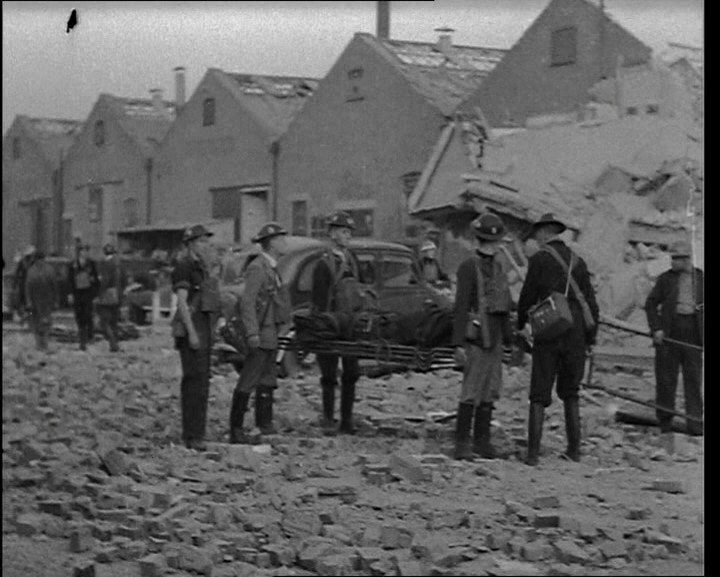
An ambulance in a bombed street: Ladywell Park, Lewisham


I chanced upon this photo, taken in the Ladywell area of Lewisham on 18 September 1940.  In common with most wartime photographs, other recorded details were excluded in case they helped the enemy.  But where was it?

The Commonwealth War Graves Commission (CWGC) holds the national register of civilians killed in the Second World War in the UK, at sea and overseas, including where they died.  From this I could see that on the 17th September there were several incidents in Lewisham but the one that seemed the best match was in a street called Ladywell Park.

No street of that name now exists, but the 1940 edition of Bartholemews Reference Atlas of Greater London revealed it was a road off of Lewisham High Street (to the east) opposite to the junction with Ladywell Road.  (Later this was the sight of Ladywell Leisure centre, now demolished.)


In the background of the photo, at right angles to Ladywell Park, a building is visible with a distinctive pediment at the roofline.  Looking at Google Maps street view, it can be matched to the building still standing at 324 to 328 Lewisham High Street.


This is the sight of the junction with Ladywell Park as it looks today:


From the book “Red Alert” by Lewis Blake, a history of the blitz in south-east London, a parachute mine exploded at 11.30pm on Tuesday 17th September.  This was a naval mine, about 6 feet long, dropped from a bomber at about 40 mph after the parachute opened.  After touching the ground, it had a timer to explode after 25 seconds and had been used for the first time in the UK on the previous night.  (For more information see https://www.iwm.org.uk/collections/item/object/30020471).  This is a painting of a mine falling in another incident:


This extract from the London County Council sows the damage done to Ladywell Park, black denoting complete destruction:


Blake says 25 people died in this incident although CWGC only lists 24 names.  These include

·         John Smart, a labourer, and four of his children at number 18

·         Richard Butler, a timberman, his wife, adult daughter, daughter-in-law and two grandchildren at number 16.  At the same address, George Johnson, a lorry driver, and two of his children.

·         At number 7, newly married Charles Lawrence, a compositor (typesetter) and his wife Kathleen.

·         At number 1, Mary White and her adult daughter Annie, who usually lived in Kentish Town with her father but was evidently visiting her mother at the time.

A common idea is that in the Blitz, Londoners slept in stations on the Underground but of course this depended on there being a station near you and that y could get a place.  Many people either chanced it at home, used a shelter in their garden, or used a public shelter in the street.  However, less than a week before at least 36 people had been killed in a public street shelter less than a mile from Ladywell Park, at Albion Way.  This might have deterred people from going to a similar shelter overnight.

The death toll could have been higher.  One of the rescuers, John Donno, a labourer, retrieved four people alive by crawling into the rubble of the houses.  He went back for a fifth person but a rubble fall knocked him out and he had to be rescued himself, awaking in hospital.  For this, he was awarded the George Medal, the highest award for civilian bravery.  Very little is known about John Donno.  Born on 18th October 1884, he lived at 56 Laleham Road at the time, with his wife, Frances. Looking at the original photo again, we can perhaps imagine him crawling into the wreckage in the middle of the night


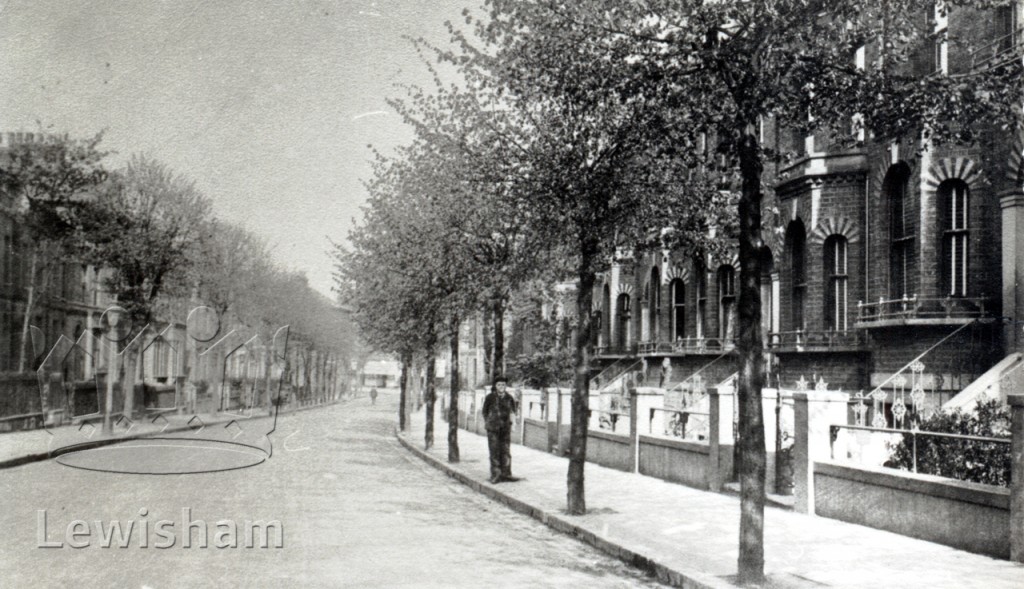
Here are two views of Ladywell Park, the first probably looking towards Lewisham High Street and the other looking towards Campshill Road:


The following aerial view shows the Lewisham URC Church on the corner of Courthill Road and Lewisham High Street in the bottom left, Lewisham High Street runs from left to right across the photo in the foreground.  Ladywell Park is the tree lined street running away from the camera on the right hand side and curving towards the centre of the photo:


This is an approximation to the same view today:


Finally, here is a close-up of the houses closest to the High Street: